
REOI: Consultancy for Poverty Measurement, Poverty Analysis, and Capacity Building the Gambia Integrated Household Survey (GIHS) 2025/26 321 views
Job Overview
Harmonizing and Improving Statistics in West and Central Africa (HISWACA)
Project Implementation Unit (PIU), C/o Gambia Bureau of Statistics,
Kanifing Institutional Layout, Kanifing, The Gambia
REQUEST FOR EXPRESSIONS OF INTEREST
Country: The Gambia
Project: Harmonizing and Improving Statistics in West and Central Africa
Grant No.: IDA E1750-GM
Assignment Title: Consultancy for Poverty Measurement, Poverty Analysis, and Capacity Building the Gambia Integrated Household Survey (GIHS) 2025/26.
Background and Context
The Gambia Bureau of Statistics (GBoS) is responsible for the production and dissemination of official statistics to support evidence-based planning, policy formulation, monitoring, evaluation, and reporting on national development priorities. As part of its mandate, GBoS is implementing the Gambia Integrated Household Survey (GIHS) 2025/26, a nationally representative household survey designed to collect comprehensive data on household welfare, consumption, labour market outcomes, demographic characteristics, and other socio-economic indicators. The GIHS 2025/26 will provide the basis for producing updated poverty and inequality estimates for The Gambia.
The Harmonizing and Improving Statistics in West and Central Africa (HISWACA) Project is a World Bank-supported regional initiative aimed at strengthening the capacity, harmonization, quality, production, and use of statistics across participating countries in West and Central Africa. In The Gambia, the HISWACA Project provides grant financing to support the strengthening of the national statistical system, including improvements in statistical production, data quality, institutional capacity, analytical capability, and dissemination of official statistics.
Through funding from the HISWACA Project, GBoS seeks to strengthen its institutional and technical capacity in poverty measurement, welfare analysis, and the use of household survey data for policy-relevant statistical outputs. In this regard, GBoS intends to engage a Technical Assistant to support the processing and analysis of GIHS 2025/26 data, construction of welfare aggregates, review or updating of the national poverty line, production of poverty and inequality estimates, preparation of methodological documentation, and capacity building of GBoS technical staff. This support is expected to enhance the quality, transparency, replicability, and institutional sustainability of poverty statistics production in The Gambia.
The assignment will be implemented in a phased manner, beginning with data quality assessment, data cleaning, and diagnostic review, followed by welfare aggregate construction, poverty line updating, poverty estimation, robustness checks, training, methodological documentation, and reporting. The technical work will depend on the timely availability of household survey datasets, price survey datasets, final household weights, previous poverty documentation, and other supporting materials to be provided by GBoS.
The resulting poverty and inequality estimates will be critical for informing national development planning, monitoring progress towards the Sustainable Development Goals, assessing welfare trends, and supporting the design and evaluation of social and economic policies in The Gambia.
Objectives of the Assignment
The overall objective of the assignment is to support GBoS in producing reliable poverty and inequality estimates from the GIHS 2025/26 and to strengthen the technical capacity of GBoS staff in poverty measurement.
The specific objectives are to:
- Support the cleaning, validation, and preparation of GIHS 2025/26 datasets required for poverty analysis, including review of key welfare measurement variables, data quality issues, missing values, skip patterns, and outliers.
- Construct a national welfare aggregate for poverty measurement, including nominal consumption aggregation, treatment of outliers, price adjustments, spatial and temporal deflators, and other methodological procedures required to produce a real consumption aggregate.
- Review and update the national poverty line using an approach to be agreed with GBoS, which may include updating the existing poverty line using price indices or constructing a new poverty line based on current survey data.
- Produce national, urban/rural, and regional poverty estimates, applying final household weights once provided by GBoS, and undertake sensitivity checks to assess the robustness of the results.
- Build the capacity of GBoS technical staff in poverty measurement methodology, including welfare aggregate construction, poverty line methodology, poverty estimation, interpretation of results, and use of STATA for poverty analysis.
- Prepare comprehensive analytical and methodological outputs, including documented syntax files, poverty results, methodological documentation, and reports required for technical review, institutional learning, and future replication.
Scope of work and key tasks
The Technical Assistant will undertake the following tasks.
Data cleaning, quality assessment, and diagnostic review
A1. Required inputs from GBoS
Before work under this phase can commence, GBoS will provide the consultant with the datasets for Quarter 1and Quarter 2, the Quarter 3 dataset if available at the time of initiation, and the corresponding price survey datasets.
A2. Data quality flagging
The consultant will conduct review of the household survey and price survey datasets to identify potential quality issues in variables critical to welfare measurement. This activity is expected to produce a structured set of flags to support early diagnosis and technical discussions before the finalization of data collection and comprehensive data cleaning.
The flagging exercise will cover two complementary dimensions. First, it will assess key variables used for poverty measurement and consumption aggregate construction, including missing values and data quality concerns. Second, it will examine missing values and non-response by the respondents, and LGA, in order to identify systematic patterns in data quality.
Indicative duration: 7 working days.
A3. Comprehensive data cleaning
The consultant will clean and prepare all relevant questionnaire sections required for poverty measurement analysis and public dissemination. The workplan specifies that this will cover all sections of the questionnaire and will include standardizing formats and display conventions, verifying internal skip logic and routing rules, checking consistency of responses across related sections, and identifying and addressing out-of-range values.
The consultant may draft do-files for this activity before the end of data collection; however, these do-files must be reviewed and finalized once data collection is complete.
Indicative duration: 22 working days, subject to preliminary review of the datasets shared by GBoS.
A4. Technical discussions and feedback sessions with GBoS
Building on the data quality flagging exercise and preliminary observations from the data cleaning process, the consultant will hold technical discussions with GBoS to jointly review flagged issues and agree on how to address missing data and data quality concerns before the comprehensive data cleaning phase is finalized.
These technical discussions will also provide an opportunity to identify any potential challenges from a sampling perspective, ensuring that gaps or anomalies in coverage are considered in the calculation and application of survey weights.
A5. Outlier detection and treatment
The consultant will detect and treat outliers in variables used for construction of the consumption aggregate. The treatment approach will be determined based on the nature and scale of identified issues. Where major outliers cannot be resolved through standard analytical methods, the consultant will engage with GBoS to clarify or address the underlying data issues.
The consultant may draft do-files for outlier detection and treatment before the end of data collection; however, these must be reviewed and finalized once data collection is complete.
Indicative duration: 5 working days.
Poverty measurement and welfare aggregate construction
B1. Required inputs from GBoS
Before work under this phase can commence, GBoS will provide complete and final GIHS 2025/26 datasets for all quarters and the final price survey dataset. These datasets are required before any sub-activity under poverty measurement can begin, as they underpin the construction of the consumption aggregate, poverty line update, and final poverty estimates.
B2. Construction of the consumption aggregate
The consultant will construct the nominal consumption aggregate and adjust it for price variation using spatial and temporal deflators. The output will be a real consumption aggregate that can be compared against the poverty line to produce poverty estimates.
This work will include, but not necessarily be limited to:
- Review of consumption-related questionnaire sections;
- Harmonization and cleaning of consumption variables;
- Treatment of missing values and outliers;
- Construction of food and non-food consumption components;
- Application of spatial and temporal price adjustments;
- Construction of the nominal and real welfare aggregates;
- Documentation of assumptions, decisions, and methodological choices; and
- Preparation of documented and replicable STATA syntax.
Indicative duration: 20 working days.
B3. Poverty line update
The consultant will support the review and updating of the national poverty line. The approach will be agreed with GBoS and may follow one of two scenarios: updating the existing 2020 poverty line by adjusting it for inflation using a price index or constructing a new poverty line from scratch using current survey data, including re-estimation of food and non-food components and additional methodological and robustness analysis.
The consultant will document the agreed methodology, data sources, assumptions, price adjustments, and robustness checks used in updating or constructing the poverty line. This activity may be drafted before the end of data collection but must be reviewed and finalized once data cleaning is complete.
Indicative duration: 15 working days.
B4. Poverty estimates and robustness checks
Once the consumption aggregate has been constructed and the poverty line has been updated, the consultant will produce poverty estimates at the national level, by urban/rural, and by LGA.
This activity is contingent on the availability of final sampling weights to be provided by GBoS. The work on final poverty estimates will commence once the final weights have been shared. The consultant will conduct sensitivity checks to verify the robustness of the results and will document the findings for technical review and institutional learning.
Indicative duration: 5 working days.
B5. Treatment of sampling weights
The preparation and finalization of sampling weights will remain the responsibility of the sampling consultant or the designated GBoS sampling team. The poverty measurement consultant will apply the finalized weights in the production of poverty and inequality estimates and will document how the weights were applied in the analysis.
Capacity building and knowledge transfer
C1. Training preparation
The consultant will prepare training materials based on the outputs of the consumption aggregate construction and poverty line update. This activity includes the development of presentation slides covering theoretical content and do-files illustrating the poverty measurement methodology.
Training preparation may begin before the end of data collection, provided that the first draft of the consumption aggregate and poverty line is available.
Indicative duration: 5 working days.
C2. In-person training on poverty measurement
The consultant will deliver in-person training to selected GBoS technical staff on poverty measurement methodology. The training will cover the theory of welfare measurement, construction of the consumption aggregate, and construction or updating of the poverty line.
The sessions are to be structured with theoretical content in the morning and hands-on practical exercises in the afternoon, following the same thematic sequence
The training will also serve as a technical review platform for discussing methodological choices made during the construction of the consumption aggregate and poverty line. This will include discussion of approaches used, reasoning behind key decisions, interpretation of results, and possible refinements emerging from GBoS feedback.
The training will be scheduled only after the consultant has had sufficient time to review, clean, and substantially advance the poverty measurement work. This reflects the comments that five days between data sharing and training is insufficient and that poverty-related analytical work should be substantially advanced before training delivery.
Indicative duration: 10 working days for poverty measurement methodology only.
C3. Mentoring and knowledge transfer
The consultant will provide structured mentoring to GBoS staff before, during, and after the training. Pre-training support will focus on data familiarization and preparation; support during the training will focus on practical application of poverty measurement methods; and post-training mentoring will support GBoS staff in reviewing outputs, interpreting estimates, consolidating skills, and ensuring replicability of the analysis.
Analytical outputs and reporting
D1. Poverty report
The consultant will prepare a poverty report presenting the results of the poverty measurement exercise. This activity can only begin once poverty estimates are in their final version. GBoS will provide the previous poverty report and all do-files and documentation, including Excel files, supporting the previous report before this activity begins.
The scope and final structure of the poverty report will be agreed with GBoS. The report should present key poverty results, interpretation of findings, disaggregated estimates, robustness checks, and comparison with previous survey rounds where appropriate and technically feasible.
Indicative duration: 10 working days, subject to clarification of the report content and scope.
D2. Methodological report
The consultant will prepare a comprehensive methodological report documenting the poverty measurement methodology. The methodological report should fully document the construction of the welfare aggregate, treatment of outliers, price adjustments, poverty line methodology, sampling weights, sensitivity checks, robustness analysis, and all key methodological choices and assumptions.
Indicative duration: 20 working days.
D3. Socioeconomic report
The consultant will support preparation of a socioeconomic report. This activity depends on GBoS providing the socioeconomic report template and any do-files or code used in previous rounds to compute the required indicators.
The duration of this activity remains to be determined, pending clarification of the report content and scope, availability of existing do-files, and availability of a template to guide estimation of workload.
Expected deliverables
The consultant will submit the following deliverables.
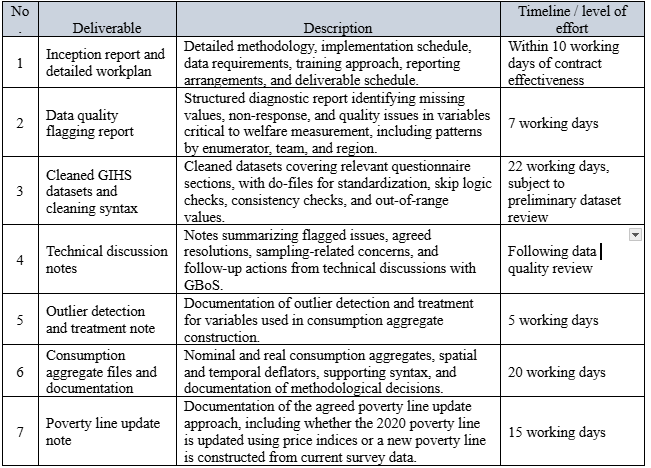
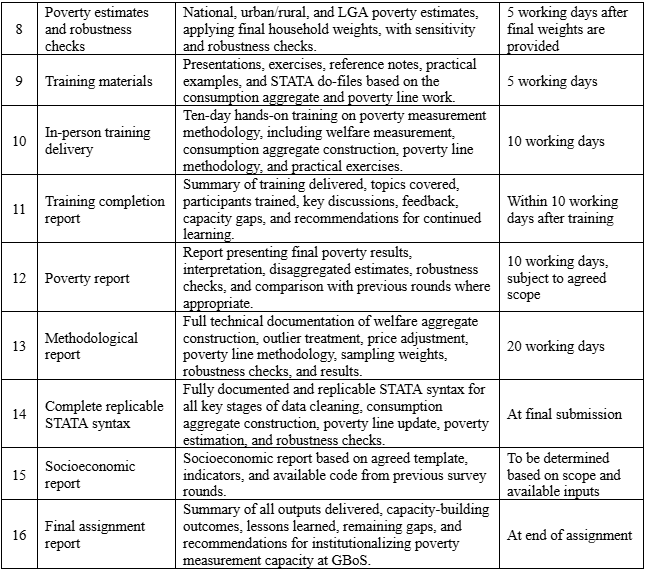
Required inputs from GBoS
GBoS will provide the following inputs to enable successful implementation of the assignment:
- Q1 and Q2 GIHS datasets, Q3 dataset if available at the time of initiation, and corresponding price survey datasets before data quality flagging and data cleaning commence.
- Complete and final GIHS datasets for all quarters and the final price survey dataset before poverty measurement activities commence.
- Final household sampling weights before final poverty estimates and robustness checks are produced.
- The previous poverty report, including the 2020 poverty report, and all supporting do-files and documentation, including Excel files, before preparation of the new poverty report begins.
- The socioeconomic report template and any do-files or code used in previous survey rounds
- Relevant survey instruments, manuals, metadata, price survey documentation, sampling documentation, previous methodological reports, and other materials necessary for effective poverty measurement and documentation.
- Technical counterparts from GBoS to participate in data review, methodological discussions, training, mentoring, and review of outputs.
Duration and level of effort
The assignment will be implemented over a 12-month contract period. This period represents the overall duration of consultant availability and technical support and does not imply a full-time engagement throughout the 12 months.
Accordingly, the estimated level of effort for activities with specified durations is approximately 120 working days, excluding activities for which the duration remains to be determined, such as the socioeconomic report and any additional STATA or data cleaning training that may be requested.
The final number of working days will be confirmed in the contract and aligned with the agreed scope of work, deliverables, reporting requirements, and availability of required inputs from GBoS.
Indicative sequencing of activities
The assignment will follow a phased sequence to ensure that training and reporting are based on sufficiently advanced technical work.
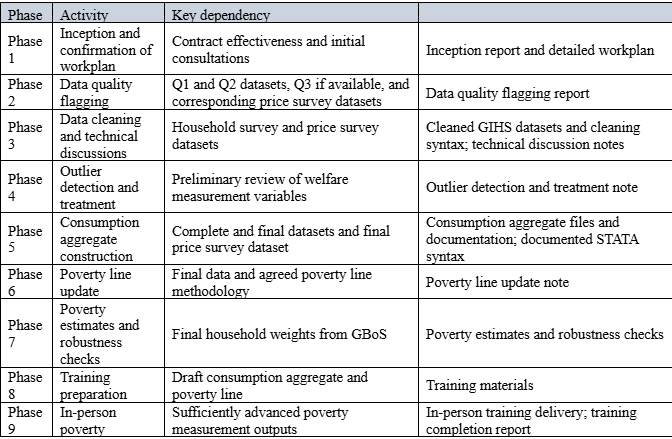
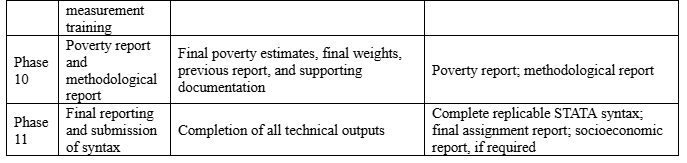
The training will not be scheduled immediately after data sharing. It will be delivered only after the consultant has substantially advanced the consumption aggregate and poverty line work.
Required qualifications and experience
The consultant should have the following qualifications and experience:
Required Qualifications
- Advanced degree in Economics, Development Economics, Statistics, Public Policy, or a related field. A master’s degree in Development Economics, Labour Economics, Econometrics, Economic Policy or a closely related discipline is required.
- At least ten (10) years of relevant professional experience in poverty measurement, welfare analysis, household survey implementation, and applied microeconomic analysis.
- Demonstrated experience in producing official poverty estimates using household survey data, including construction of consumption aggregates and updating or constructing national poverty lines.
- Strong technical expertise in welfare measurement, consumption aggregation, poverty line methodology, poverty estimation, inequality analysis, robustness checks, and policy-relevant poverty diagnostics.
- Proven experience supporting national statistical offices or government counterparts in the implementation, cleaning, validation, analysis, and dissemination of household survey data.
- Demonstrated experience in end-to-end household survey implementation, including questionnaire design, sampling coordination, CAPI programming or validation, real-time data quality monitoring, data cleaning, and final dataset preparation.
- Advanced proficiency in statistical analysis and programming software, particularly STATA, with additional experience in Python, R, or other relevant analytical tools considered an advantage.
- Demonstrated ability to prepare replicable analytical syntax, methodological documentation, poverty and inequality reports, policy briefs, and technical outputs for official and policy use.
- Proven experience designing and delivering capacity-building activities, technical workshops, mentoring, and hands-on support to government or national statistical office staff in poverty measurement and data analysis.
- Strong written and oral communication skills in English, with the ability to prepare clear technical documentation and communicate complex analytical issues to technical and non-technical audiences.
Required Experienced
- Experience working with the World Bank, UN agencies, national statistical offices, or other international development institutions on poverty, welfare, household survey, or social policy assignments.
- Experience supporting poverty measurement and welfare analysis in low- and middle-income country contexts, including fragile or institutionally complex settings.
- Experience working across different regional contexts, including West Africa.
- Experience preparing poverty reports, socioeconomic reports, methodological notes, policy briefs, and quality assurance documentation for official statistics or development policy purposes.
- Familiarity with survey platforms and tools such as Survey Solutions, Power BI, GitHub used for data collection, visualization, reproducibility, and analytical workflow management.
Reporting and supervision
The consultant will report to the Director of Social Statistics at GBoS and will work closely with the GIHS technical team, the Project Implementation Unit (PIU), and other designated technical counterparts.
Regular technical meetings will be held throughout the assignment. Meetings will be held more frequently during intensive data processing, poverty measurement, training, and output review periods, and at least monthly during other phases of the assignment unless otherwise agreed.
All key outputs, including cleaned datasets, syntax files, poverty estimates, training materials, poverty report, methodological report, and final assignment report, will be subject to review and approval by GBoS.
Institutional arrangements
GBoS will provide the consultant with access to all relevant datasets, price survey data, survey instruments, documentation, metadata, previous reports, sampling documentation, and technical counterparts required to complete the assignment.
The consultant will coordinate with the sampling consultant or designated sampling team to ensure that final household weights are correctly applied in poverty analysis. GBoS will facilitate participation of relevant technical staff in training, mentoring, technical discussions, and review of outputs.
The consultant will use his or her own computer, software, and technical equipment required to complete the assignment.
Travel and logistics will be covered under a lump-sum arrangement. The consultant will be responsible for arranging and covering travel, accommodation, and related logistics within the agreed lump sum. Local transportation will be facilitated by GBoS. No separate reimbursement will be made unless explicitly provided for in the contract.
Payment schedule
Payments will be linked to the satisfactory completion and approval of deliverables. The payment percentages below are indicative and may be adjusted by the PIU during contract finalization, based on the agreed scope of work, level of effort, and contract negotiations. The final payment schedule will be reflected in the signed contract.

Application Requirements
Interested candidates should submit the following:
- Technical proposal describing the proposed methodology, workplan, sequencing of activities, capacity-building approach, and understanding of the assignment.
- Financial proposal, including professional fees and all applicable travel and logistical costs where relevant.
- Updated curriculum vitae demonstrating relevant qualifications and experience.
- Examples of previous similar work, such as poverty analysis reports, methodological documentation, where available.
- References from previous assignments of similar nature.
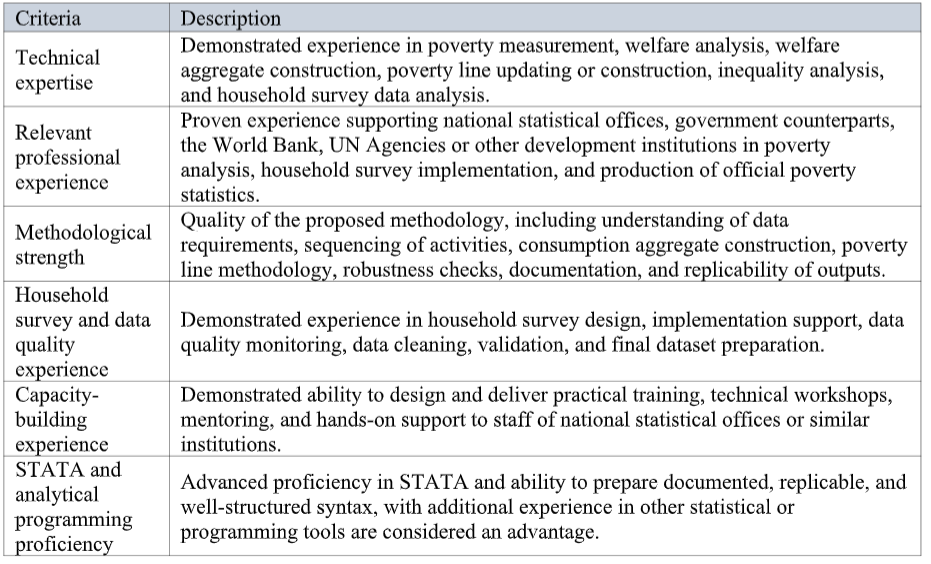
Evaluation criteria
The consultant will be assessed based on the following criteria:

Contact information and submission of applications
For inquiries and submission of applications, candidates may submit their applications either in physical copies or electronically to the following:
Selection Method
The consultant will be selected accordance with the Individual consultant’s selection method set out in the Procurement Regulations 2025 September of the World Bank. The attention of interested Consultants is drawn to Section III, paragraphs, 3.14, 3.16, and 3.17 of the World Bank’s “Procurement Regulations for IPF Borrowers” September 2025 (“Procurement Regulations”), setting forth the World Bank’s policy on conflict of interest.
Expressions of interest must be delivered in a written form to the address below (in person or by e-mail) by 16:00 hours GMT on or before 4th August, 2026.
Project Implementation Unit (PIU)
Gambia Bureau of Statistics (GBoS)
ATTENTION: Mr. Mohammed L. Janneh, Project Coordinator
C/o Gambia Bureau of Statistics, Bijilo, The Gambia West Africa
Tel: 7296325, 9824270, and 2827526
E-mails: hiswacainfo@gbosgov.org mjannehhiswaca@gbosgov.org smendyhiswaca@gbosgov.org
ejabanghiswaca@gbosgov.org hydarakutubhiswaca@gbosgov.org