
(REOI): Individual Consultant for the Mid-Term Review of the HISWACA Project – The Gambia 265 views
Job Overview
Harmonizing and Improving Statistics in West and Central Africa (HISWACA)
Project Implementation Unit (PIU), C/o Gambia Bureau of Statistics,
Mansa Musa Faal Complex, Bijilo West Coast Region
TERMS OF REFERENCE
Individual Consultant for the Mid-Term Review
Assignment title: Individual Consultant for the Mid-Term Review of the HISWACA Project – The Gambia
Project: Harmonizing and Improving Statistics in West and Central Africa – Series of Projects 1 (HISWACA-SOP1)
Project ID: P178497
Country financing: The Gambia: IDA Grant E1750 – US$30 million
Client: Gambia Bureau of Statistics / HISWACA Project Implementation Team
Consultant category: Individual consultant
Primary output: A comprehensive, evidence-based and forward-looking Mid-Term Review Report, with proposed corrective measures, project changes where warranted, and an actionable implementation plan.
Background and project context
The HISWACA-SOP1 project was approved by the World Bank Board of Executive Directors on 11 May 2023. The operation covers eight participating countries and three regional organisations. Following additional financing for Guinea-Bissau, total project financing is US$464 million. The Gambia participates through IDA Grant E1750 in the amount of US$30 million.
The project seeks to enhance the quality, accessibility and production of regionally comparable statistics. It is intended to improve country statistical performance, regional harmonisation, data access and use, and modernisation of the statistical system. The regional approach supports coordination among National Statistics Offices and Ministries, Departments and Agencies responsible for statistics, while encouraging the use of harmonised methods, tools, modern technologies and new or alternative data sources.
The Project Development Objective is to improve country statistical performance, regional harmonisation, data access and use, and to enhance modernisation of the statistical system in participating countries.
The project is organised under four components:
- Component 1: Harmonisation and Production of Core Statistics using International Data Quality Standards. Activities support regional and continental statistical harmonisation and production of quality core economic, social, demographic, agricultural, climate, sectoral and subnational statistics.
- Component 2: Statistical Modernisation, Institutional Reform, Human Capital, Data Accessibility and Use. This supports modern methods and organisations, institutional reforms, improved access and dissemination, data use, human capital development and the use of new data sources and advanced technologies.
- Component 3: Construction, Upgrading and Modernisation of Physical Infrastructure. This strengthens physical, ICT and statistical infrastructure, equipment, software and working environments for statistical institutions.
- Component 4: Project Management, Monitoring and Evaluation. This supports project management, monitoring of results and user satisfaction.
Rationale for the Mid-Term Review
The Mid-Term Review is a critical assessment conducted at the midpoint of project implementation. It provides an opportunity to take stock of implementation progress, assess achievements and emerging results, identify challenges and lessons learned, and determine whether the project remains on track to achieve its intended objectives.
The overall Mid-Term Review process will be undertaken in two interrelated stages. The first stage will focus on preparatory work, evidence gathering, independent assessment, stakeholder consultations, identification of implementation challenges, and formulation of proposed corrective measures and project adjustments. The second stage will involve stakeholder validation and consideration of the findings, recommendations, and agreements arising from the preparatory stage.
The independent consultancy constitutes a key technical input into this process. The consultant will provide the evidence, analysis, findings, and recommendations required to inform stakeholder discussions and decisions during the validation and endorsement stage.
The review shall be forward-looking and shall identify practical measures required to improve project performance during the remaining implementation period. Where justified by evidence, the review may recommend adjustments to project design, implementation arrangements, the Results Framework, operational procedures, resource allocation, or other relevant project parameters.
Purpose of the Consultancy
The purpose of the consultancy is to independently assess the performance and implementation of the HISWACA Project in The Gambia at mid-term and produce a rigorous, evidence-based, forward-looking, and decision-oriented Mid-Term Review Report.
The consultant shall lead the technical assessment during the preparatory stage of the Mid-Term Review process and provide technical support during the validation and finalisation stage. The assignment shall take stock of implementation progress, assess achievements and emerging results, identify lessons learned, diagnose constraints and risks, evaluate the continued relevance and adequacy of project arrangements, and recommend corrective measures and a prioritised action plan for the remaining implementation period.
The consultant’s findings and recommendations shall provide an objective technical basis for stakeholder validation, agreement on corrective actions, and consideration of any necessary revisions to relevant project instruments or implementation arrangements.
Objectives of the Assignment
- Assess progress toward achievement of the PDO and determine whether the PDO remains relevant and achievable.
- Assess the appropriateness, measurability and continued validity of PDO and intermediate results indicators.
- Take stock of implementation progress against planned activities, milestones, deliverables and expected results.
- Assess progress by component and determine how component activities are contributing to the PDO.
- Identify implementation successes, lessons learned and factors that have contributed to positive results.
- Document implementation challenges, including anticipated and unforeseen constraints, delays and their effects on progress.
- Assess the adequacy of project design, implementation plan, costs, timing and viability in relation to the project closing date.
- Assess project management and implementation arrangements and whether the available mix of skills remains appropriate.
- Assess procurement, financial management, environmental and social framework implementation, results monitoring, legal covenant compliance and project risks.
- Recommend practical corrective measures, any justified project adjustments, and a time-bound action plan for the remaining implementation period.
- Provide independent evidence and analysis to support the preparatory stage of the Mid-Term Review process.
- Facilitate validation of the review findings and recommendations and incorporate agreed stakeholder comments into the Final Mid-Term Review Report.
Scope of Work
The consultant shall undertake the assignment through two interrelated stages. Stage 1 shall comprise the preparatory, evidence-gathering, consultation, and analytical activities required to produce the Draft Mid-Term Review Report. Stage 2 shall comprise stakeholder validation, refinement of proposed corrective measures and project changes, incorporation of consolidated comments, and finalisation of the Mid-Term Review Report.
All findings shall be supported by verifiable evidence obtained through document review, project monitoring information, stakeholder consultations, and other appropriate sources. The report shall distinguish clearly among confirmed findings, identified evidence gaps, proposed corrective measures, and recommendations requiring consideration or approval by the appropriate authorities.
Project Development Objective and project description
- Assess progress toward achievement of the PDO.
- Determine whether the PDO remains relevant and achievable in the current context.
- Review whether the PDO indicators remain appropriate for measuring the intended results.
Overall implementation status
- Assess overall implementation progress against expected results, planned milestones and deliverables.
- Examine progress on intermediate outcomes and the contribution of component activities to the PDO.
- Identify constraints, issues and delays, including effectiveness or other implementation delays where applicable.
- Assess actions already identified or implemented to address constraints and whether those actions are succeeding.
Progress by component
- Assess performance under each of the four project components and relevant subcomponents implemented in The Gambia.
- Identify completed, ongoing, delayed or pending activities and explain the evidence-based implications for results.
- Assess the relationship between expenditures, outputs, intermediate outcomes and anticipated PDO-level results.
Adequacy of project design
- Assess whether the project components and their content, scope and sequencing remain adequate to achieve the PDO.
- Identify any design elements requiring adjustment and provide a detailed rationale for proposed changes, including expected outputs and results.
Adequacy of the implementation plan
- Assess whether the implementation plan remains valid in terms of content, costs and timing.
- Assess the viability of completing planned activities within the remaining implementation period and before the closing date.
- Where required, propose updates to costs, procurement planning, disbursement scheduling and implementation sequencing.
Project management and implementation arrangements
- Assess whether internal implementation and management arrangements are functioning and remain appropriate.
- Assess coordination, decision-making, oversight and the adequacy of the mix of skills available to the client and the World Bank project teams.
- Recommend modifications to implementation or management arrangements where evidence demonstrates a need.
Procurement
- Assess the status and timeliness of procurement implementation.
- Identify procurement delays and their causes, including internal approval delays where present.
- Assess the sufficiency, skills and training of procurement staff in World Bank procurement and contract-management procedures applicable to Investment Project Financing.
- Recommend actions to address procurement constraints and support timely completion of planned transactions.
Financial management
- Describe and assess financial planning, financial management arrangements and internal controls.
- Assess funds absorption and identify any material disbursement lags and their causes.
- Review the status of Interim Financial Reports, audits and other required financial reports, including any overdue submissions and corrective actions.
- Recommend measures to strengthen financial management performance and address identified gaps.
Environmental and Social Framework
- Assess monitoring and reporting against the Environmental and Social Commitment Plan, Stakeholder Engagement Plan and other applicable environmental and social instruments.
- Assess whether the Grievance Redress Mechanism is in place and functioning.
- Identify compliance gaps and recommend a practical action plan to address them.
Results framework and monitoring
- Assess whether the Results Framework remains valid and whether indicators can be measured.
- Review availability, quality and timeliness of monitoring data.
- Assess whether M&E arrangements are functioning and adequate.
- Determine whether indicator definitions, baselines or targets should be revised, and provide an evidence-based justification for any recommendation.
Legal covenants
- Review the legal covenants in the Financing Agreement and document each covenant, its due date and status at mid-term.
- Identify any non-compliance or delayed compliance and recommend corrective action.
Risks
- Assess whether country, sector, implementation or other relevant risks have changed.
- Determine the implications of changed risks for project design and implementation.
- Recommend revised risk-management measures and timing where required.
Conclusions, lessons and proposed changes
- Synthesise the principal conclusions and lessons learned.
- Confirm continued borrower commitment or identify implications where commitment requires attention.
- Prepare a summary table of proposed changes, responsible parties, timing and follow-up arrangements.
- Present a prioritised action plan for the remaining implementation period.
Review Questions
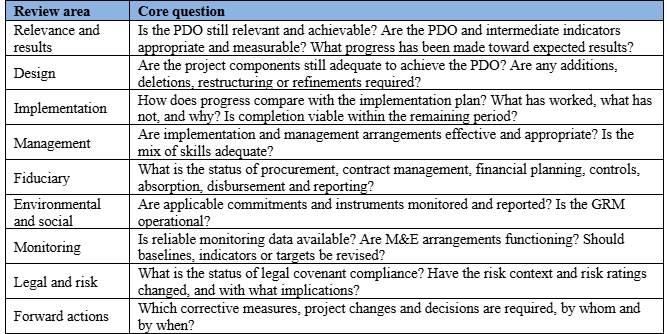
Methodology and Approach
The consultant shall propose a detailed methodology in the Inception Report. The methodology shall be aligned with the two-stage structure of the assignment and shall be consultative, evidence-based, transparent, participatory, and focused on practical and actionable findings.
Stage 1 methodology
The preparatory and analytical stage shall include:
- A structured desk review of the Financing Agreement, project design documents, Project Operations Manual, Results Framework, implementation plans, progress reports, Implementation Support Mission reports and aide-memoires, procurement and financial management records, environmental and social instruments and reports, legal covenant records, risk information, and other relevant evidence made available for the review;
- Consultations with relevant implementing partners, Ministries, Departments and Agencies, project personnel, oversight institutions, users of statistics, development partners, and other relevant stakeholders;
- Assessment of planned versus actual implementation progress, outputs, intermediate results, expenditures, and anticipated PDO-level results;
- Analysis of the Objectively Verifiable Indicators and other indicators contained in the Results Framework;
- Review of whether project risks, assumptions, undertakings, and implementation conditions have changed;
- Identification of emerging challenges, lessons learned, remedial measures, and any potential revisions to project arrangements or instruments;
- Triangulation of documentary evidence, monitoring information, financial data, and stakeholder consultations; and
- Clear documentation of evidence limitations and outstanding information gaps.
Stage 2 methodology
The validation and finalisation stage shall include:
- Presentation of preliminary findings and recommendations to the client and relevant stakeholders;
- Structured validation of the factual accuracy, feasibility, responsibility, sequencing, and timing of proposed actions;
- Documentation of stakeholder comments, decisions, and areas of agreement or disagreement;
- Preparation of a comment-response matrix;
- Incorporation of relevant consolidated comments into the Final Mid-Term Review Report; and
- Finalisation of the proposed corrective measures, project changes, and prioritised action plan.
The consultant shall maintain independence of judgment throughout the assignment. Stakeholder validation shall verify evidence, improve the practicality of recommendations, and document agreed actions, but shall not compromise the independence of the consultant’s findings.
Expected Deliverables
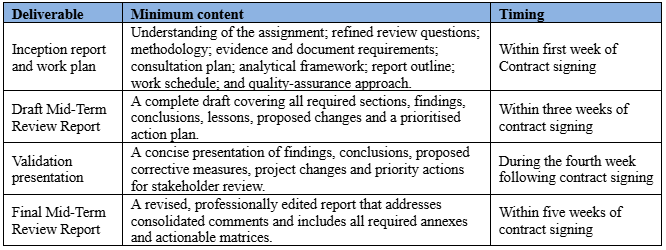
All deliverables shall be submitted within the timelines indicated above and shall be subject to review and formal acceptance by the client. The consultant shall incorporate consolidated comments received during the validation process into the Final Mid-Term Review Report.
Payment Milestones
Payments shall be made upon satisfactory completion, submission and formal acceptance of the corresponding deliverables by the client, in accordance with the consultancy contract. The proposed payment schedule is:
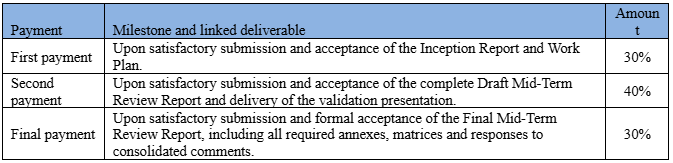
Submission alone does not constitute acceptance. Each payment is conditional upon written confirmation that the relevant deliverable meets the requirements and quality standards of this Terms of Reference and the consultancy contract.
Minimum Technical Qualifications and Experience
The individual consultant should demonstrate qualifications and experience commensurate with the breadth and technical demands of the assignment. In particular, the consultant shall meet the following minimum requirements:
- An advanced university degree in statistics, economics, development studies, monitoring and evaluation, public policy, project management, finance, social sciences, or another field directly relevant to the assignment.
- Demonstrated experience conducting mid-term reviews, evaluations or implementation assessments of complex development projects.
- Strong knowledge of results-based management, project design, Results Frameworks, indicators, monitoring systems and corrective-action planning.
- Ability to assess project implementation across technical, institutional, procurement, financial management, environmental and social, legal and risk dimensions.
- Experience with statistical capacity development, official statistics, National Statistical Systems, data access and use, statistical modernisation or related fields would be a strong advantage.
- Familiarity with World Bank-financed Investment Project Financing operations, including implementation, procurement, financial management, environmental and social, results monitoring and legal compliance requirements, would be an advantage.
- Excellent analytical, consultation, facilitation, report-writing and presentation skills in English.
- Demonstrated ability to translate complex evidence into clear, practical and prioritised recommendations.
Reporting, Coordination and Review Arrangements
The consultant shall report to the client-designated authority and work closely with the HISWACA Project Implementation Team. The consultant shall coordinate document requests, consultations, validation and submission of deliverables through the designated focal point. Deliverables shall be subject to review and acceptance by the client in accordance with the contract.
The client shall facilitate reasonable access to available project documents and relevant stakeholders. The consultant shall consolidate and address comments in a transparent manner and shall provide a comment-response matrix with the final report if requested by the client.
Duration, Assignment Stages and Work Plan
The consultancy shall be undertaken over a period of forty-five (45) days, commencing from the effective date specified in the consultancy contract. The assignment shall be implemented through the following two interrelated stages, aligned with the overall Mid-Term Review process:
Stage 1: Preparatory, Evidence-Gathering and Analytical Stage
During the first stage, the consultant shall undertake the substantive technical work required for the independent Mid-Term Review. This stage shall include:
- Conducting a structured review of relevant project documents, including the Results Framework, implementation progress reports, Implementation Support Mission reports and aide-memoires, procurement and financial management records, environmental and social documents, and other relevant materials;
- Consulting relevant government institutions, implementing partners, Ministries, Departments and Agencies, project personnel, data users, development partners, and other relevant stakeholders;
- Assessing progress against the Project Development Objective, intermediate results indicators, planned outputs, component and subcomponent targets, implementation schedules, and available financial information;
- Taking stock of the findings and recommendations arising from relevant government assessments, implementation support missions, and other project reviews;
- Identifying implementation achievements, emerging challenges, changed risks and assumptions, lessons learned, and areas requiring corrective intervention;
- Assessing whether the project remains on track to achieve its intended objectives and results;
- Identifying and analysing any recommended changes to project parameters, implementation arrangements, the Project Operations Manual, or the Financing Agreement, where such changes are supported by the review findings;
- Preparing the Inception Report and Work Plan; and
- Preparing and submitting the Draft Mid-Term Review Report, including findings, conclusions, lessons learned, proposed corrective measures, recommended project changes, and a prioritised action plan.
The first stage shall culminate in the submission of the Draft Mid-Term Review Report for review by the client and relevant stakeholders.
Stage 2: Validation, Finalisation and Endorsement Support Stage
The second stage shall focus on validating the findings and recommendations developed during the preparatory stage and finalising the Mid-Term Review Report. During this stage, the consultant shall:
- Prepare and deliver a concise validation presentation covering the principal findings, conclusions, lessons learned, proposed corrective measures, recommended project changes, and priority actions;
- Present the findings and recommendations to the client and relevant stakeholders at a validation workshop or meeting;
- Facilitate technical discussion of the findings and document the comments, decisions, and agreements arising from the validation process;
- Review the implications of stakeholder feedback for the proposed corrective measures, implementation arrangements, Project Operations Manual, Financing Agreement, Results Framework, targets, risks, and action plan, as applicable;
- Incorporate relevant consolidated comments and agreed revisions into the report;
- Prepare a comment-response matrix showing how substantive comments have been addressed; and
- Submit the Final Mid-Term Review Report, including all required annexes, matrices, proposed changes, and the final prioritised action plan.
The second stage shall culminate in the submission and formal acceptance of the Final Mid-Term Review Report.
Indicative Work Plan and Deliverable Schedule
The consultant shall submit, as part of the Inception Report, a detailed and realistic work plan covering the full 45-day assignment period. The work plan shall clearly indicate the sequencing, duration, and interdependence of activities under the two stages.
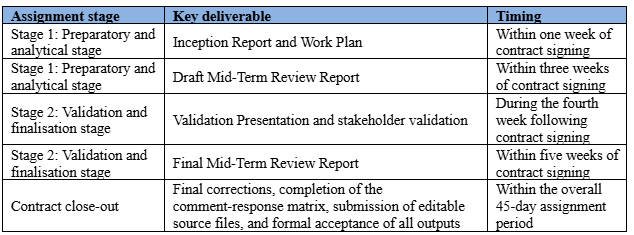
All deliverables shall be submitted within the timelines specified above and shall be subject to review and formal acceptance by the client. The consultant shall incorporate relevant consolidated comments received during the validation process before submitting the Final Mid-Term Review Report.
Quality Standards and Acceptance Criteria
- Completeness: all scope areas and required report sections are addressed.
- Evidence: findings are based on reviewed documentation, monitoring information or stakeholder consultations and are clearly traceable.
- Analytical rigor: the report explains progress, gaps, causes, implications and corrective options rather than merely listing activities.
- Consistency: conclusions and recommendations follow logically from findings.
- Actionability: proposed actions identify priorities, responsibilities, timing and intended results.
- Clarity: the report is concise, well structured, professionally edited and suitable for decision-making.
- Forward focus: the review provides practical solutions and justified project changes needed to support successful implementation.
Confidentiality, Independence and Ownership
The consultant shall treat project documents and information received during the assignment as confidential and shall use them solely for the purposes of the consultancy. The consultant shall disclose any actual or potential conflict of interest and maintain professional independence and objectivity. All reports, matrices, presentations and other outputs produced under the assignment shall become the property of the client, subject to the terms of the consultancy contract.
Application Submission Requirements
Interested and qualified applicants are invited to submit their applications by close of business on Friday, 25 September 2026. Applications may be submitted either electronically or in hard copy.
Electronic Submissions
Applications submitted electronically should be sent to the following email addresses:
hydarakutubhiswaca@gbosgov.org
Hard Copy Submissions
Hard copy applications should be delivered to:
Mr. Mohammed L. Janneh
HISWACA Project
Mansa Musa Faal Complex
Bijilo, The Gambia
Application Labelling
Applicants should clearly indicate the position title, “Individual Consultant for the Mid-Term Review of the HISWACA Project in The Gambia,” in the subject line of electronic submissions or on the envelope containing a hard copy application.