
Technical Consultant – Black Soldier Fly (BSF) Farming Pilot in The Gambia 173 views
Job Overview
Scaling-Up Organic Fertilizers in The Gambia, Advancing Nutrition, Innovation and Circular Economy (S-Organic) Project
Background
The Gambia is a least developed country, and the predominant economic activity in this country is agriculture. The agriculture and horticulture sector employs approximately 80% of the population. The horticulture sector is mainly dominated by small scale producer’s majority of whom are women and youth. While core grain production mainly relies on rain-fed agriculture, horticulture projection is largely conducted during the cold season-September-December. One major constrain that the Gambian horticulture producers are faced with is low level of soil fertility. Horticulture production is usually done in communal farms within confines of as low as 0.5hectres and as big as 8hectares.
The area is usually shared among a group of women and/youths and per capita share of space is always low (5-10 beds of 1*10meters/bed). This has led to continuous cultivation of vegetables on the same area of land every cold season. The frequent tillage of the soil for vegetable production has reduced the production capacity of the soil leading to yields.
This has led to continuous reliance on chemical fertilizer to increase crop yields for increased food security, enhanced nutrition and increase in household income by vegetable growers. The constant use of chemical fertilizer which is less cost effective has led to further depletion of soil fertility, contributed to incidence of crop failures e.g. onion bulb-rod experienced by farmers was associated with the constant and increased use of chemical fertilizer in vegetable production by many women vegetable growers and it has led to a significant drop in yields and reduced the self-life of onions.
Coupled with high cost of fertilizer due to the COVID-19 pandemic and the war on Ukraine, the S-organic project was developed to support and promote the production, sales and usage of organic fertilizer and compost across the 6 agriculture regions of The Gambia.
WasteAid is the lead implementer to the project and has received funding from the European Union (EU) to implement the final year project activities after the closure of United Purpose operations in The Gambia in December 2025. WasteAid is piloting the Black Soldier Fly (BSF) farming in The Gambia as part of its efforts to promote organic production in The Gambia and is recruiting a technical consultant to support this initiative.
Organic waste management and rising costs of animal feed pose significant economic and environmental challenges. Black Soldier Fly (BSF) farming offers a circular economy solution by converting organic waste into high-quality insect protein for animal (poultry and fish) feed and nutrient-rich frass for organic fertilizer.
This initiative aims to establish a pilot BSF farming operation to test local feasibility, optimize production parameters, and build local capacity. The project requires a technical consultant to design, launch, and stabilize the pilot facility.
Objectives
The objective of this consultancy is to provide technical expertise to strengthen and upscale an existing small scale Black Soldier Fly (BSF) farming pilot in 2 One will be situated in Kartong, West Coast Region in collaboration with NACCO Enterprise.
NACCO Enterprise is a private company that has started a small BSF pilot in Kartong. Another one will be in Yundum, West Coast Region at National Agriculture Research Institute (NARI). NARI is an agricultural research institution working on the technical aspects of organic fertilizer and compost production and has signed MoU with S-organic project since 2024. As a research institution, NARI is well positioned to support in scaling up BSF production with women vegetable growers in The Gambia in the future.
The consultant will support improved production systems, operational management, technical documentation, and capacity building to ensure the pilot becomes a sustainable and scalable model for organic waste management and insect protein production in The Gambia.
Scope of Work and Specific Objectives
The BSF farming pilot will be conducted in 2 project intervention sites. In Kartong and in NARI demonstration farm.
The consultant will be responsible for the following tasks:
Site Assessment & Design: Evaluate the selected pilot site in NARI. And provide recommendations for practical production facility layouts, workflow, breeding systems, optimizing zones for egg hatching, larval rearing, pupation, and adult breeding (love cages), waste handling zone and all other relevant zones, putting in place biosecurity measures for operational efficiency purposes. For NACCO, the consultant will assess the existing BSF pilot facility and recommend practical improvements to production layout, workflow, breeding systems, larval rearing, waste handling, and overall operational efficiency, with biosecurity measures built in at each stage.
Substrate Formulation: Analyze locally available organic waste streams. Develop optimal feed recipes and moisture-control protocols for the larvae.
Sourcing & Colonization: Source the initial BSF starter culture (eggs or larvae). Establish biosecurity measures to prevent wild pest infestation and pathogen outbreaks.
Equipment Specification: List and specify cost-effective local materials and equipment. This includes rearing crates, ventilation systems, shredders, and harvesting sieves.
Capacity Building: Deliver hands-on training to local facility managers and operators on daily colony maintenance and troubleshooting. The consultant will provide practical training for approximately 12 pilot operators, 6 from each group on BSF production, breeding management, waste handling, harvesting, processing, record keeping, troubleshooting and business management.
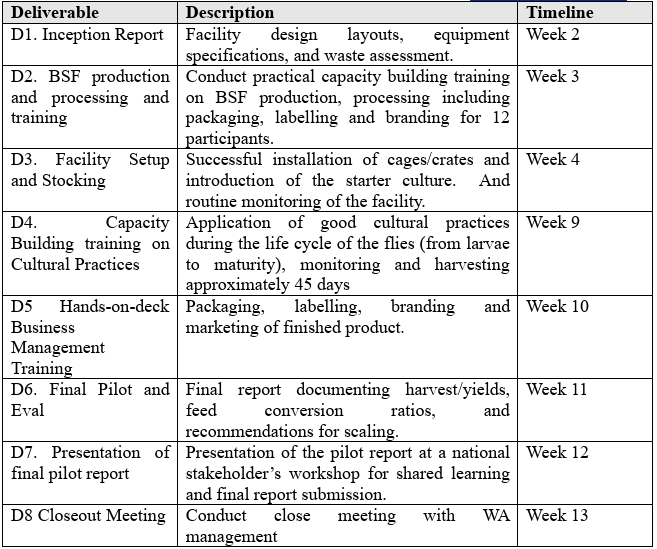
Deliverables and Timelines
The consultancy is expected to be completed within a period of 4 months.
Reporting Requirement
The consultant will produce the following reports:
- An inception Report: The consultant will produce a draft inception report within a period of 1 week and submit it to WA program team and the pilot facility manager for review. The turnaround time for the review is 3 working days, and the consultant is expected to submit the final document by the end of the 2nd week.
- Monthly Progress Reports: The consultant shall submit three (3) monthly progress reports throughout the consultancy. These reports shall document activities undertaken, technical improvements implemented, production progress, challenges encountered, recommendations, and actions for the following month.
- Final Pilot Progress Report: The consultant will submit a draft progress report by the end of week 11. This will be reviewed in week 12 and the final progress report will be submitted by the end of week 13.
Duration of Work
This consultancy will be conducted within a period of 4 months.
Roles and Responsibilities of the Consultant
- The consultant shall submit a Programmatic and Financial Proposal
- The consultant shall provide a detail activity framework
- The consultant shall provide all the necessary costings for the pilot including cost of tools, equipment and material needed to operationalize the pilot.
- The consultant shall adhere to reporting timelines
Institutional Arrangement
- The consultant will report directly to Project & Consortium Coordinator, S – Organic Project.
- The client will provide the physical site, raw waste inputs, utilities, and necessary budget for infrastructure procurement.
- The consultant will conduct weekly progress
Application Guidelines
- Both institutions and individual consultants can apply for this consultancy. However, we encourage individual consultants to apply.
- All applicants should submit a C.V, covering note, technical and financial proposal document.
- Where a group/an institution applies, the lead consultant should submit a C.V, covering note, technical and financial proposal document on behalf of the team. And provide credentials for all team members.
- The deadline for submission of applications is Friday, the 28th of August 2026 at 13:00hrs,
- All submissions shall be done online via the following link: procurement@wasteaid.org .
- Please note, no late application will be
Required Qualifications and Experience
- Minimum of a bachelor’s degree in Entomology, Animal Science, Agronomy, Environmental Science, or a related field.
- Proven hands-on experience (minimum 3 years) in establishing and managing BSF production facilities.
- Strong understanding of insect biology, climate control, and waste-to-feed conversion parameters.
- Demonstrated experience in developing technical training materials and coaching staff in low-resource environments.
- Excellent technical writing and communication
Skills and Competencies The BSF farming requires several technical and expert skills including biology, engineering, and business skills. The consultant must understand the insect’s life cycle, control their environment, manage waste safely, and plan for consistent
Key skills and core competencies include:
- BSF Biology & Ecology– Understanding the four life stages—adult, egg, larva, and pupa; Life Cycle Management; Behavioral Observation and Mating
- Environmental Control-climate regulations, humidity control and airflow management
- Waste Management & Nutrition– Feed Formulation, Safety & Sorting and Waste Processing
- Harvesting & Post-Processing- Separation Techniques and Processing
- Business & Operations- Supply Chain and Quality
Terms of Payment
- Payment shall be made by instalment. 1st disbursement will be 40%, 2nd disbursement will be 30% and the 3rd and final disbursement will be 20% of the contractual amount and there will be 10% withholding tax.
- 1st instalment payment shall be done within 5 working days upon signing of the contract by both parties and submission of a signed invoice to WasteAid.
- 2nd disbursement shall be made within 5 working days upon receipt of the SOP and Training Manual and a signed invoice
- Final disbursement of funds shall be made a period of 2 upon satisfactory completion of work, submission of final Pilot Report and a signed invoice by the consultant to the contracting authority.
- The consultant shall provide WasteAid with signed receipts within 5 days upon receipt of funds/cheque.
- WasteAid shall deduct a withholding tax of 10% of the total contractual amount. WasteAid shall submit this amount to The Gambia Revenue Authority (GRA) for tax compliance purposes. WasteAid shall provide the consultant with all the necessary documentation which shall be presented to GRA by the consultant for tax clearance purposes.